ON THIS PAGE
- Frog and Toad Basics
- Species Information
- Become a FrogWatch Community Scientist
- Learn More About Frogs and Toads
Frog and Toad Basics
Did you know that every toad is considered a frog, but that not every frog is a toad? Frogs and toads make up the largest group of amphibians, with nearly 8,000 known species worldwide, and there are ways to recognize members of the four families found in Montgomery County:
- True Frogs (Family Ranidae)
- Treefrogs (Family Hylidae)
- True Toads (Family Bufonidae)
- Spadefoot Toads (Family Scaphiopodidae)
All species found in Montgomery County lay eggs in wetlands and other aquatic habitats. These eggs lack shells, have a jelly-like appearance, and may be placed individually or together in clumps, masses, rafts, or strands visible at the top of the water, attached to plant material, or hidden completely. Tadpoles develop in the center of each egg and hatch as free-swimming larvae, feeding primarily on algae and plants before going through metamorphosis and exiting to land, but the timing of this phenomenon is also variable and can take as little as a few weeks to multiple years. Once on land, frogs and toads predominantly eat insects, worms, and other invertebrates, although some will eat any animal small enough to fit in their mouths, including other frogs.
Frogs and toads are closely associated with the condition of the water and the surrounding land and are sensitive to pollution and changes in the environment. A healthy environment supports a diversity of frogs and toads that are seen and heard year after year. Declines and disappearances may signal a problem due to water quality impairment, disease, or habitat loss.
Species Information
Frog and toad species are identified by distinct physical traits and breeding calls. Most are active from spring to late summer, although seasonal patterns and habitat preferences vary. Some species are common and widespread, while others are more specialized, or there are gaps in our understanding of where they occur within Montgomery Parks.
True Frogs
True Frogs (Ranidae Family) have a robust body covered in smooth, soft skin with a moist appearance. A stout waist and long, muscular legs allow for long jumps and powerful kicks, and the hind feet are webbed between each toe, making them skilled swimmers.
Look closely for the presence of ridges and skin folds to help distinguish species; most have a pair of raised skin folds that begins behind each eye and continues down the back, known as dorsolateral ridges. Eggs are round and laid in grape-like clusters (masses) or as a single layer on the water’s surface (rafts). Tadpoles are relatively large but vary in appearance across species.
Breeding calls are low, deep, and complex. Some, like the American Bullfrog, are able to make dramatic grunts, squeals, and squeaks to deter competing males and startle potential predators.
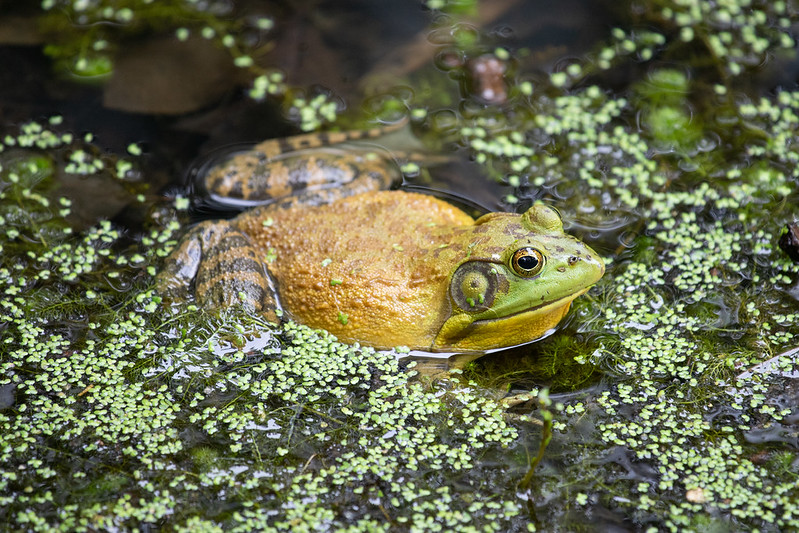
Lithobates catesbianus
Habitat: Can be found in nearly all freshwater habitats, but prefer larger water bodies like lakes, ponds, and slow portions of streams and rivers to limit competition among highly territorial males.
Seasonality: Typically calls from late April through August, but may be seen well into late fall.
Call: Low and deep, resembling the bellow of a bull, given as a single “moo” or multi-syllable “jug-o-rum”.
Description: Largest frog in Montgomery County, sometimes exceeding 6″. Skin smooth and primarily green, olivaceous, or brown on the back and sides and white, cream, or yellowish underneath. Skin is occasionally adorned with a contrasting net-like pattern when mature, or very small, precise spots when young. Dorsolateral ridges are absent, but a fold of skin wraps around the ear drum (tympanum) from behind the eye.
Notes: One of the most common species in Montgomery County, and found in all types of parkland, including urban and neighborhood parks with stormwater ponds.
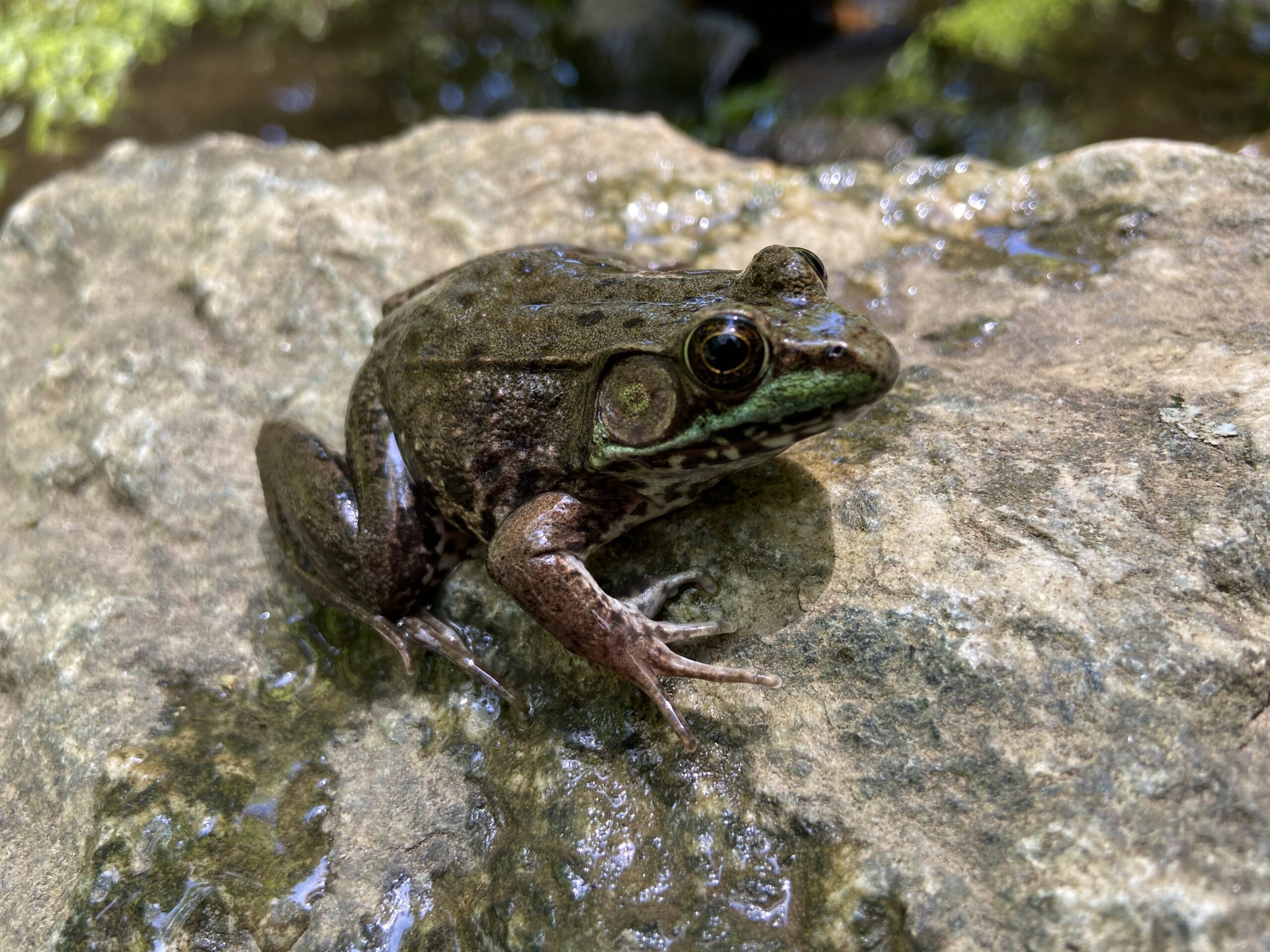
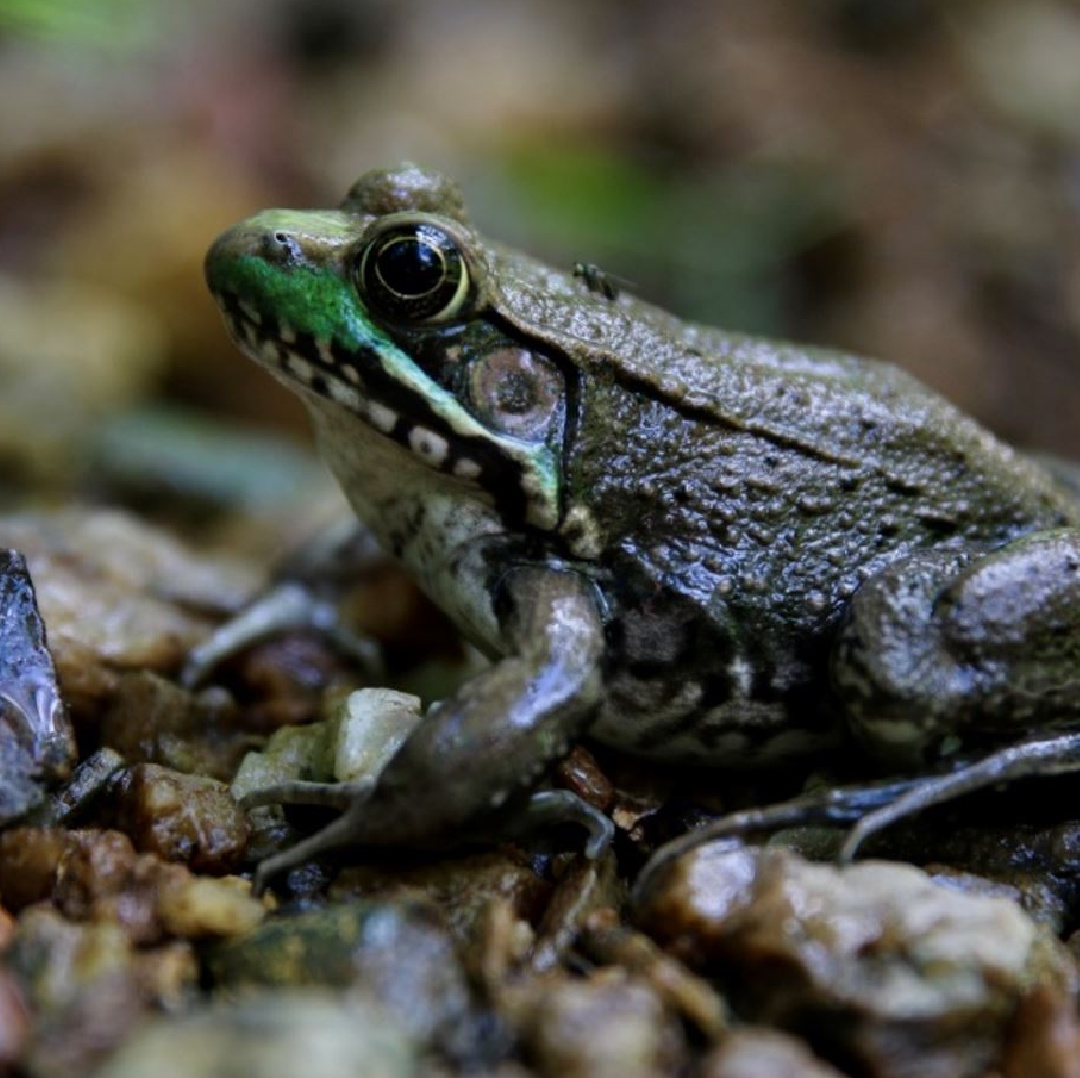
Lithobates clamitans
Habitat: Aquatic habitat generalist that can be found in nearly every freshwater habitat, including swamps, marshes, ponds, lake margins, and streams.
Seasonality: Found in aquatic habitats year-round, but typically heard calling May through August.
Call: An accented “cl-Tung” made as a single burst or that gets progressively quieter across multiple syllables: “cl-Tung-tung-tun”. Often described as a “broken banjo string” with an overall quality that is hollow and dull.
Description: Generally drab olive-colored or brown with obscure dark spots or blotches on the back. Some individuals will have a green upper lip or green wash over the head. A pair of dorsolateral ridges extends from behind the eyes down to the hips. Like the American Bullfrog, males have tympana that are roughly double the diameter of the eyes and develop a bright yellow throat during breeding season.
Notes: Very common throughout Montgomery Parks and frequently heard and seen along streams and a variety of wetland habitats.
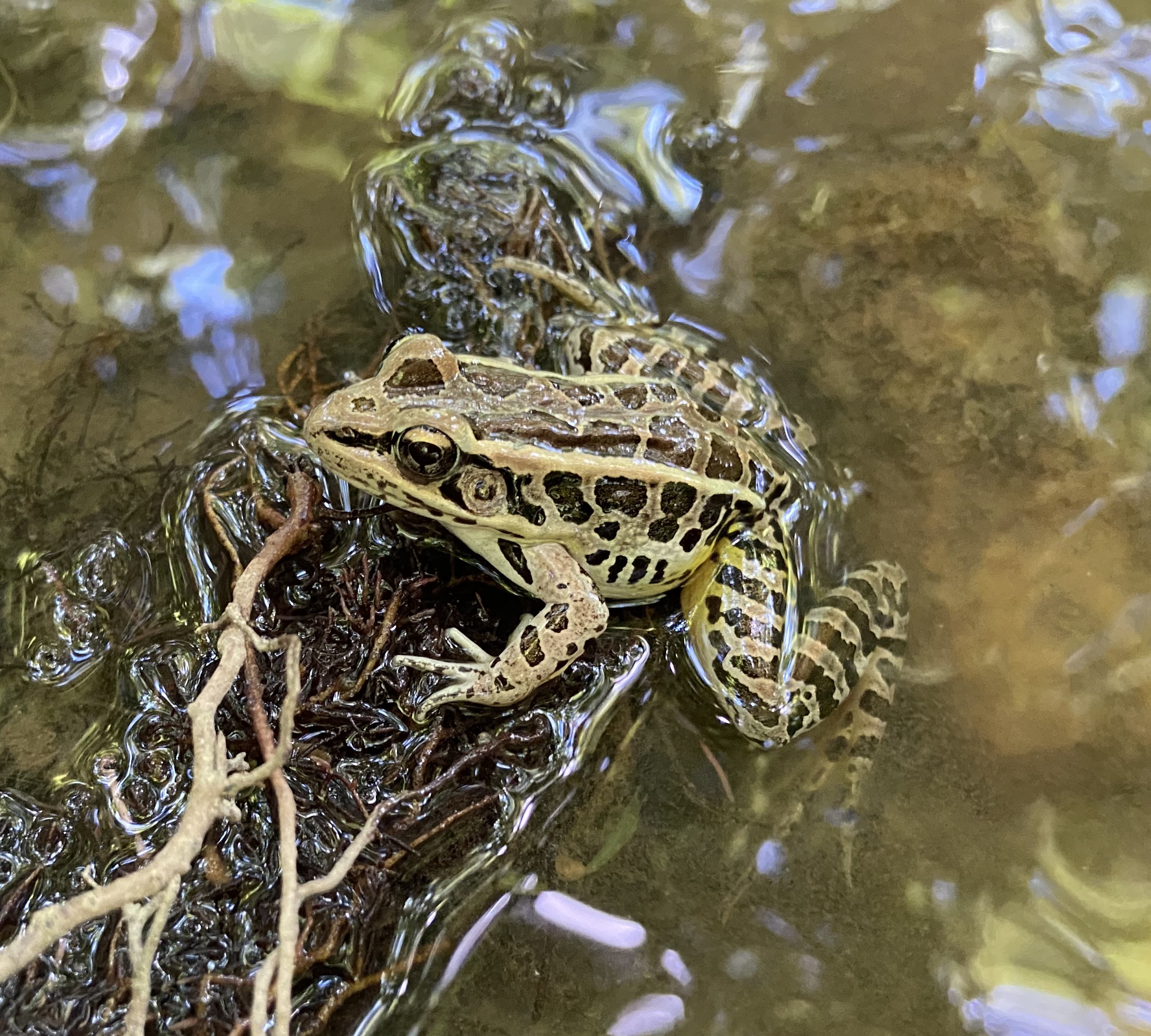
Lithobates palustris
Habitat: Primarily breed in marshes, swamps, and ponds in the spring and often observed along streams and in marshes outside of the breeding season. Will also call from lake margins with dense emergent vegetation such as cattails.
Seasonality: Springtime breeder heard calling from March through early May but active along streams and wetlands through the fall.
Call: Steady, low, and lazy snore-like croak lasting up to 2 seconds. Muffled, subtle, and rolling “RRRrrrrr”.
Description: Brown to bronze-colored with two parallel rows of squarish brown spots running down the back between two lighter-colored dorsolateral ridges that run from behind the eyes to the hips. Additional spots adorn the sides and legs, with the rear legs appearing striped in some individuals. The throat and belly are white, and the inner thigh is yellow or orangish. The snout is rounder and blunter when compared to the Southern Leopard Frog.
Notes: Call may be difficult to hear, especially when made underwater or among other calls, such as Spring Peeper choruses.
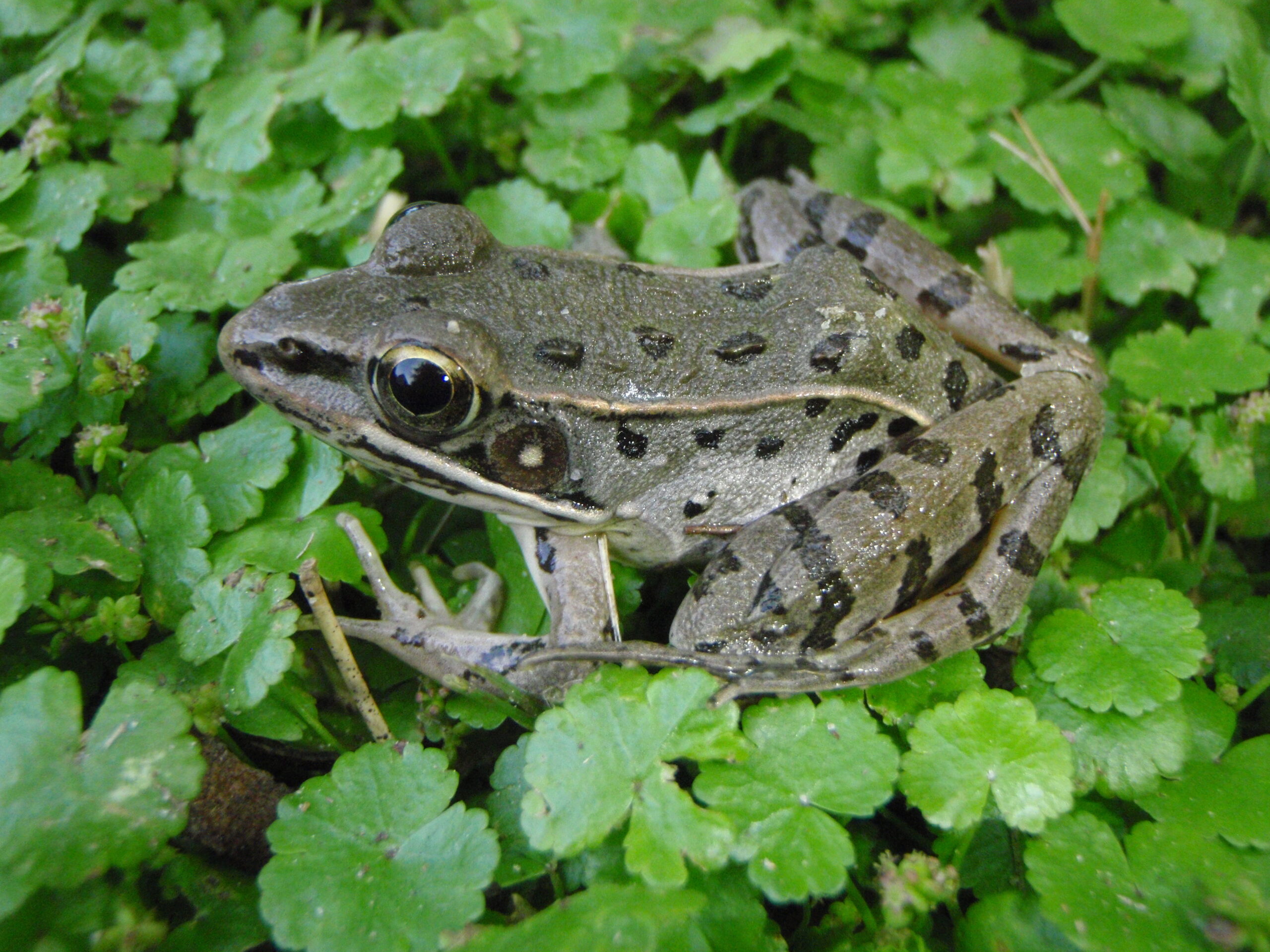
Lithobates sphenocephalus
Habitat: Found along swamps, ponds, marshes, and slow-moving streams, but prefers to breed in wetlands without fish.
Seasonality: Early season breeder heard from late February through April.
Call: Series of short, throaty chuckle-like croaks or clucks given in rapid succession, followed by a low growl, which may be described as “Wa-a-a-a-wa-a-a-a-wa-a-a-a-rrrrrrup”. Will occasionally make a brief, stand-alone growl that sounds like a hand rubbing across a balloon – “Rrrrup”.
Description: Color varies from brown to green, and the body and legs are covered in dark, round, scattered spots. The dorsolateral ridges appear as prominent, light-colored folds that run from behind the eye down to the hips. A similar light line typically appears along the upper lip, and the snout is pointed and slightly downturned. A distinct, precise white or light-colored spot appears in the center of each tympanum.
Notes: Uncommon in Montgomery County but frequently observed in portions of Prince George’s County and the District of Columbia.
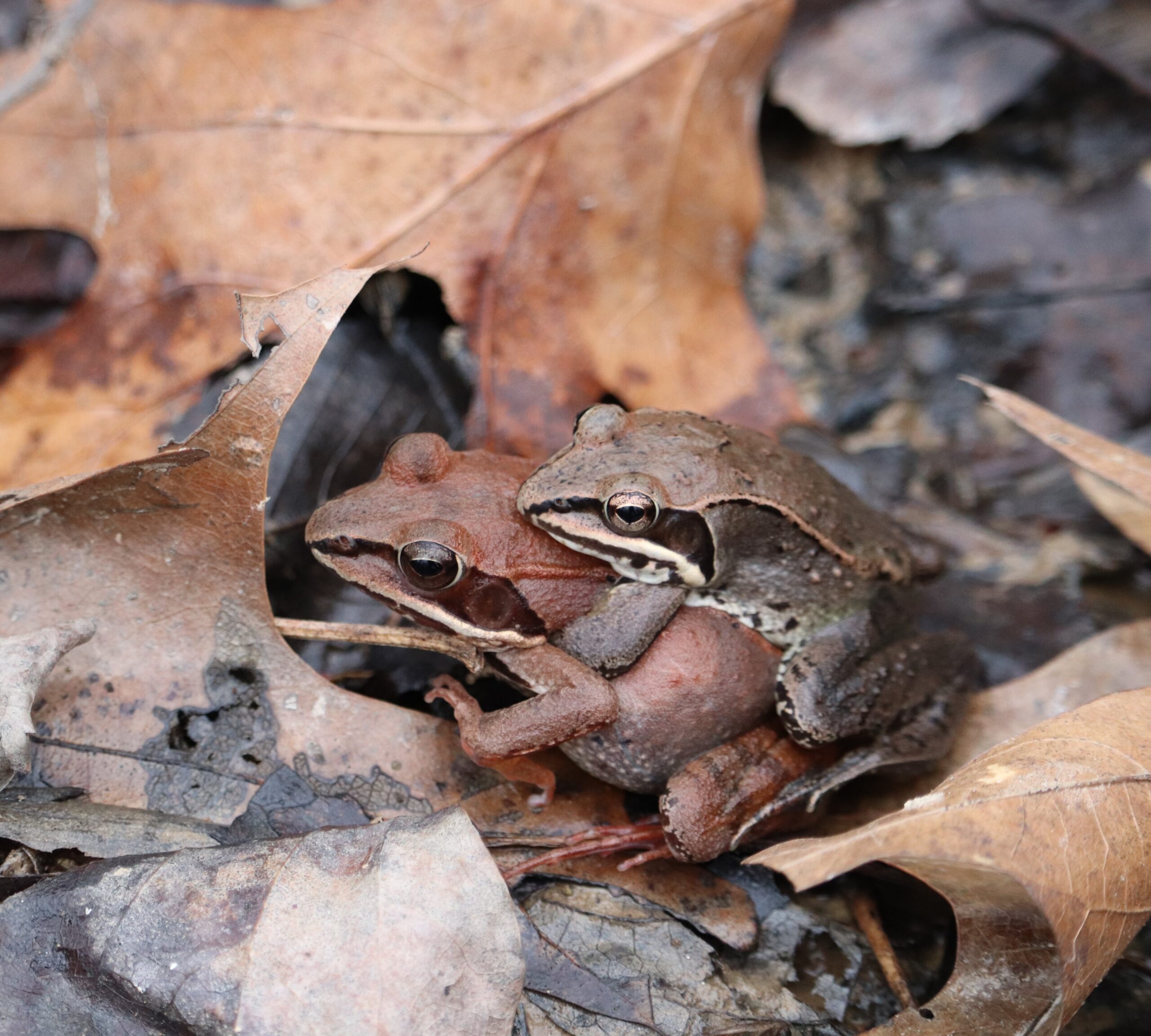
Lithobates sylvaticus
Habitat: Closely associated with seasonal wetlands and considered an obligate vernal pool species. Migrate and congregate at breeding pools in early spring before dispersing to surrounding woodlands.
Seasonality: Early season breeder heard calling from February through the end of March.
Call: Repetitious duck-like cackling, clucking or quacking, often made by many individuals together in large groups. Sound may be described as a muted “Wo-oh-oh, wo-oh-oh, wo-oh-oh.”
Description: Brown or tan with a contrasting, dark mask extending through the eye and downward to the rear of the mouth. Dorsolateral ridges are present and the same color as the rest of the body. Males are typically darker and smaller than females, which can be pinkish-tan during the breeding season.
Notes: Considered “explosive breeders” that congregate in large numbers after the first warm rains of late winter or early spring. Eggs are laid in grape-like masses, individually or in large communal deposits. Both adults and egg masses are tolerant to freezing conditions.
Treefrogs
Treefrogs (Hylidae Family) have slim waists and long limbs that are well-adapted for climbing. Each toe has a modified toe pad for climbing as well, but the size and shape varies among the three local genera:
- True Treefrogs (Hyla / Dryophytes sp.) have large, round toe pads. They are the largest members of the treefrog family and are the most adept climbers, spending a great deal of time in trees and clinging to tall vegetation. They also sport broad mouths and prominent eyes.
- Chorus Frogs (Pseudacris sp.), including the Spring Peeper, are small in stature with small rounded to squarish toe pads. They spend the majority of their time tucked among grasses and low-lying vegetation, but will also climb onto shrubs and wetland plants.
- Cricket Frogs (Acris sp.) are small with slightly rounded toe tips. They more closely resemble True Frogs (Family Ranidae) at first glance and favor sunnier, more open habitats than other treefrog species.
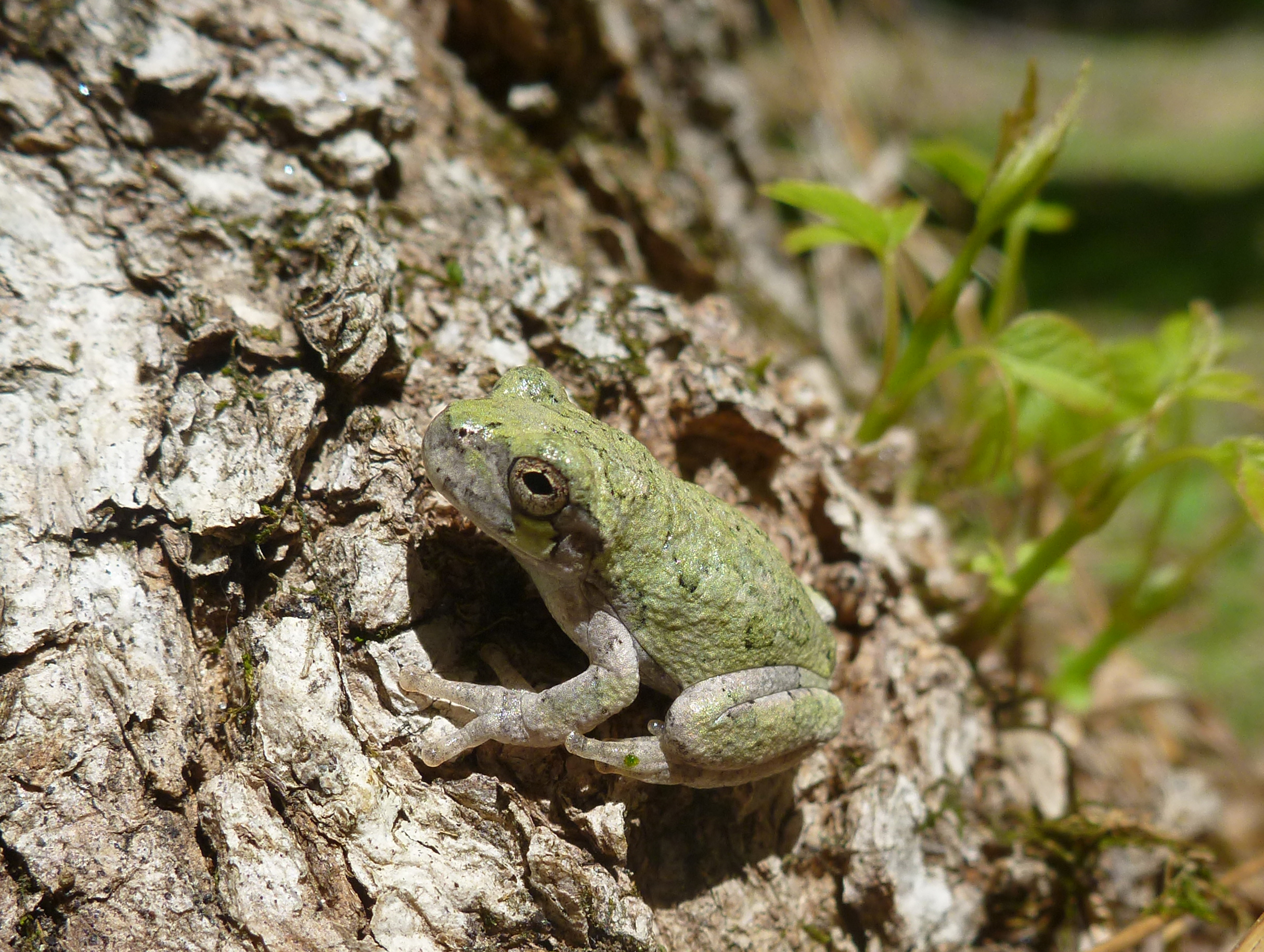
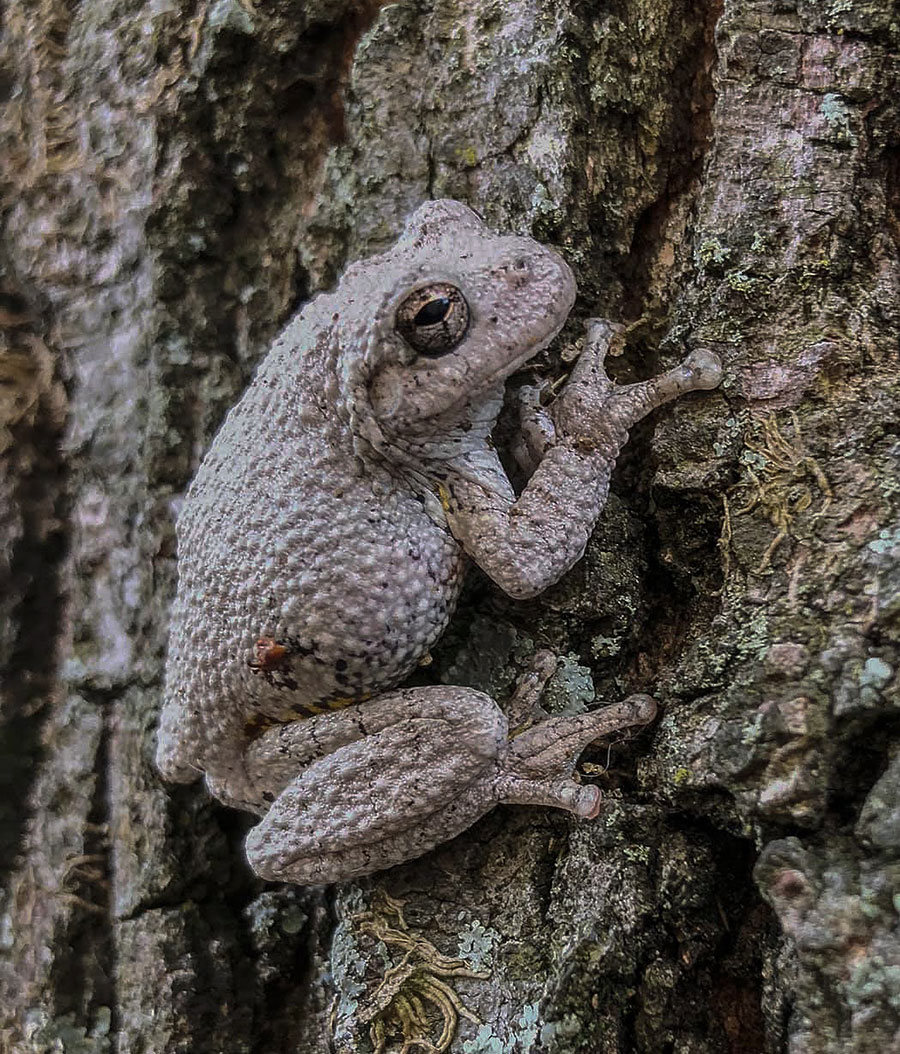
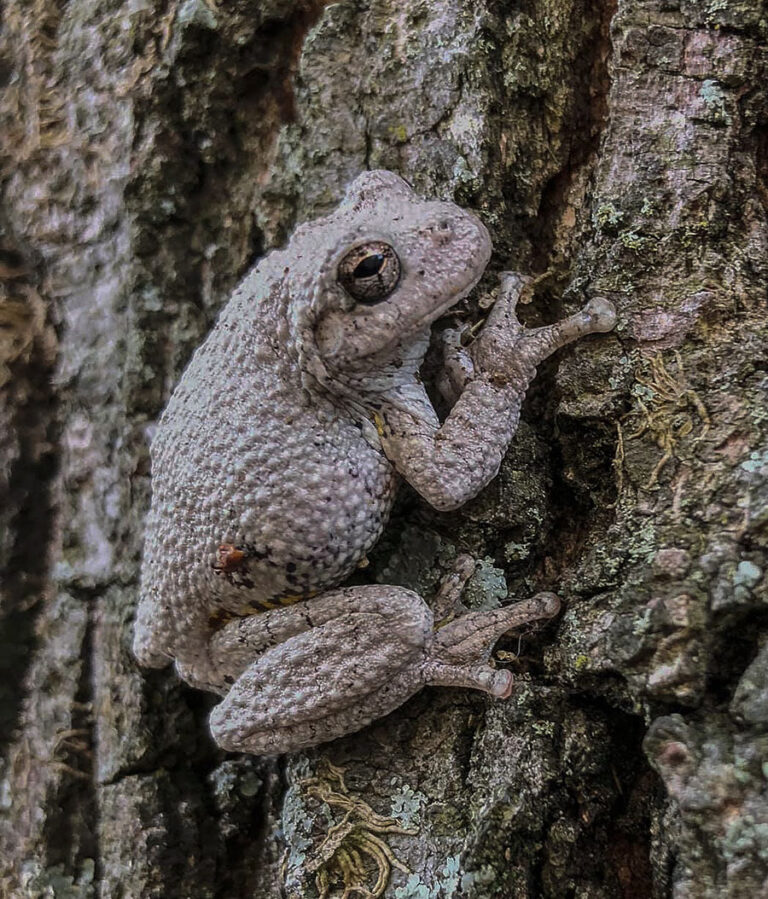
Hyla versicolor & Hyla chrysoscelis
Habitat: Primarily swamps and wet wooded areas, and in close proximity to shrubs and trees. Congregate along the edges of ponds, swamps, and ephemeral wetlands to breed.
Seasonality: April through July, and sometimes into August.
Call:
- Gray Treefrog – A clear, rippling, and resonating trill. Described as more musical/melodious and bird-like when compared to the closely related Cope’s Gray Treefrog.
- Cope’s Gray Treefrog – A hearty, raspy, and somewhat brash trill that is faster and with more pulses than the Gray Treefrog. It is described as more ratchet-like or squirrel-like in quality.
Description: White, gray, or greenish with contrasting lichen-like patterns along the back. Skin is highly glandular and covered in small bumps. A distinct white rectangle appears beneath each eye, and there is a yellow-to-orange wash across the inner thighs. Both species are identical in appearance to one another and can only be differentiated by call or genetic analysis.
Notes: The two species can co-occur and may be heard calling from the same habitat and at the same time. Individuals will also call from high in the trees during the day, and prior to and following rain.
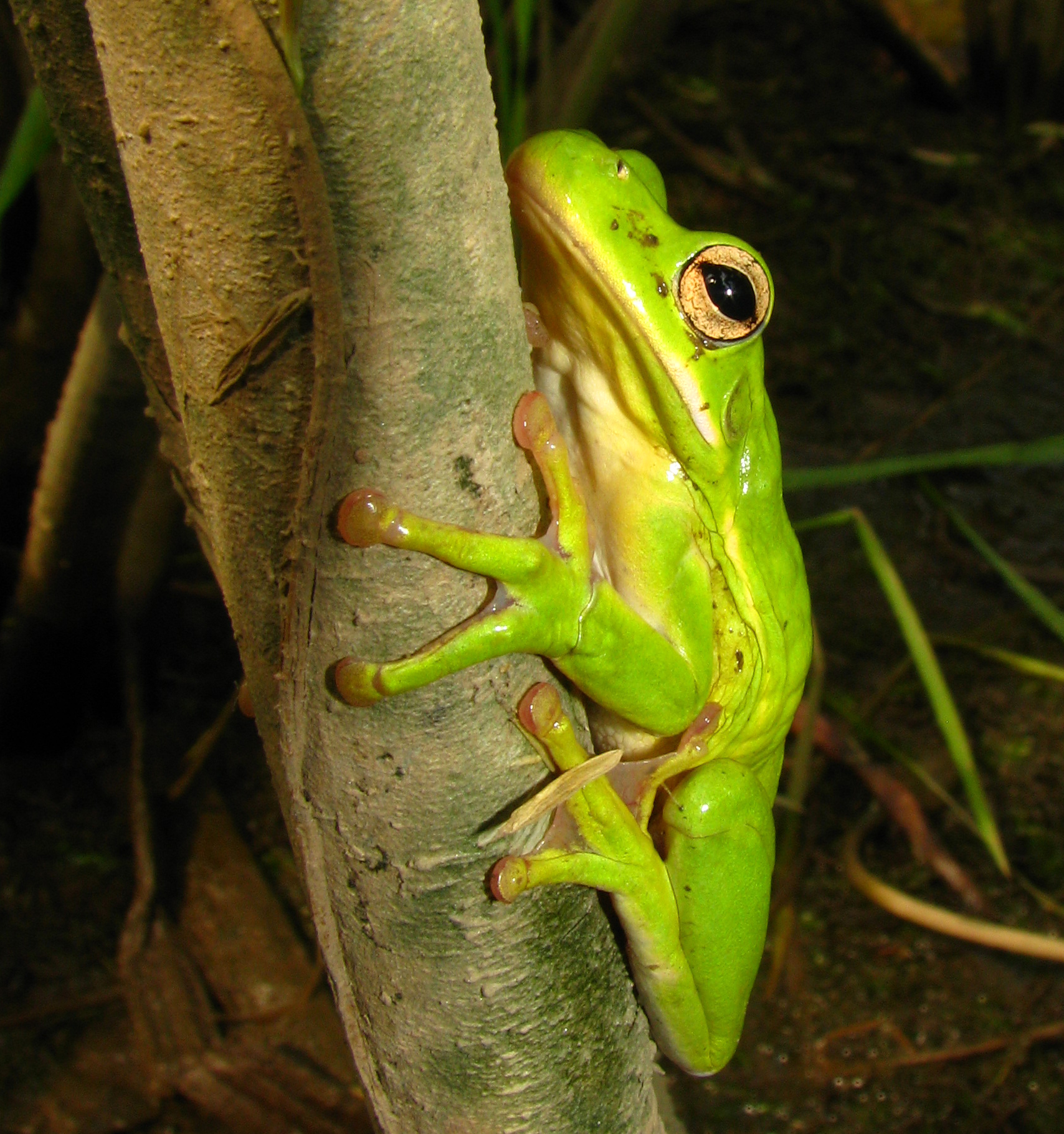
Hyla cinerea
Habitat: Marshes, swamps, ponds, lakes and ditches. Prefers areas with dense emergent vegetation.
Seasonality: Summer breeder heard from May through August.
Call: Boisterous, rapid and nasal-sounding call described as a “Quank” or “Quenk” repeated upwards of 75 times.
Description: Exotic-looking with smooth, bright green skin and a light-colored underside. Individuals may be pure green or will have a white lip line that extends along the side as well as scattered gold spots.
Notes: Uncommon in Montgomery County. Populations may be the result of a range expansion from the Coastal Plain or as hitchhikers on wetland and nursery plants.
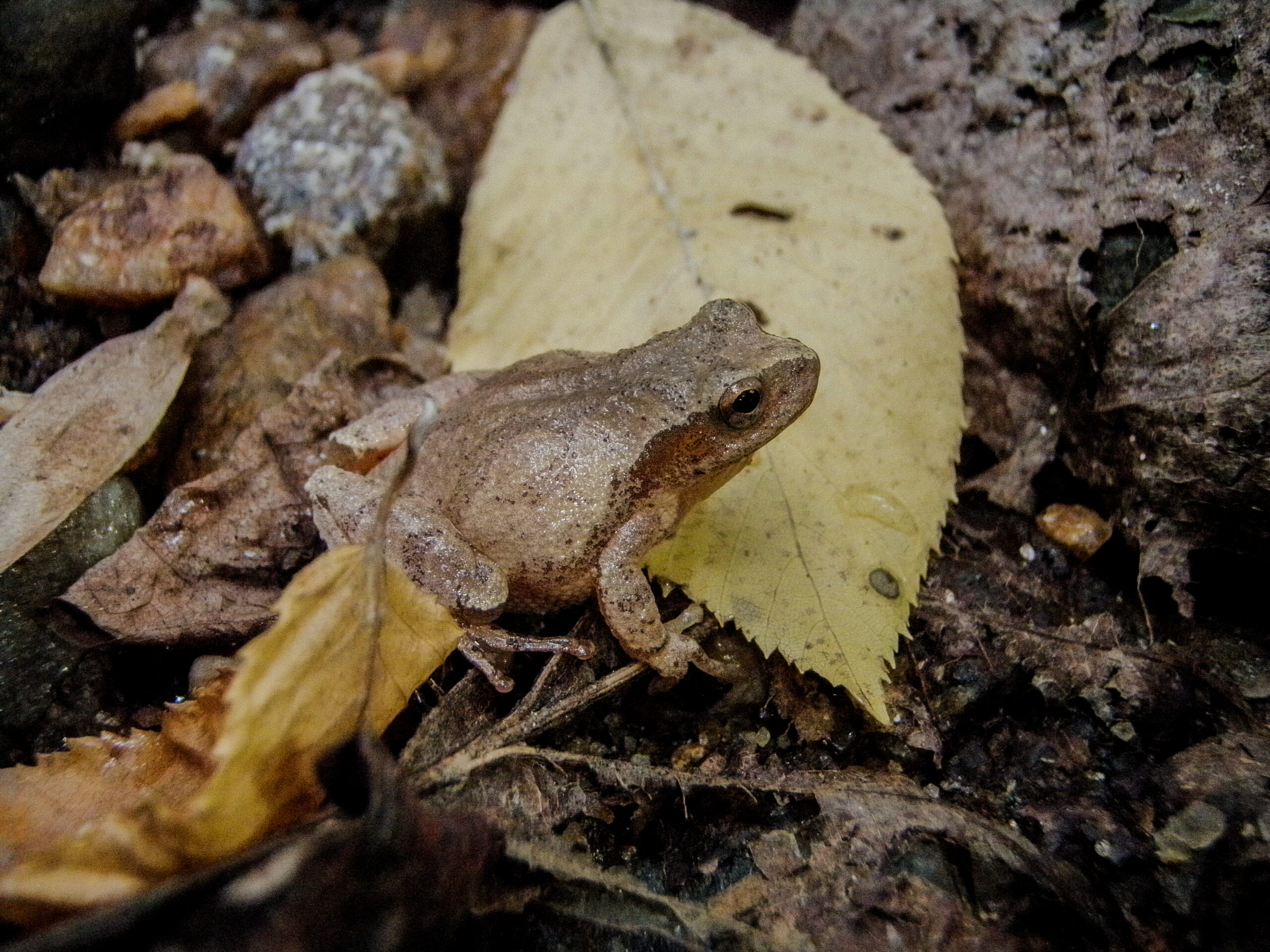
Pseudacris crucifer
Habitat: Cattail marshes, wooded swamps, and other vegetated wetlands where they can congregate in large numbers.
Seasonality: Early season breeder heard from late February into early May.
Call: High-pitched whistle (“peep”) given once per second, most often in a multiple-frog chorus. Bird-like cheep that is somewhat piercing/biting in quality. Agonistic (encounter) call is a sharp “prrreep” which can be confused with the Upland Chorus Frog (Pseudacris feriarum).
Description: Tiny and typically tan to yellowish-brown with a dark-brown X marking across the back. A faint mask may be present across the eyes, nose, and tympana, and individuals often have a dark bar on the top of the head between the eyes.
Notes: More easily heard than seen and will often call tucked among grasses and wetland plants with only the head peeking out.
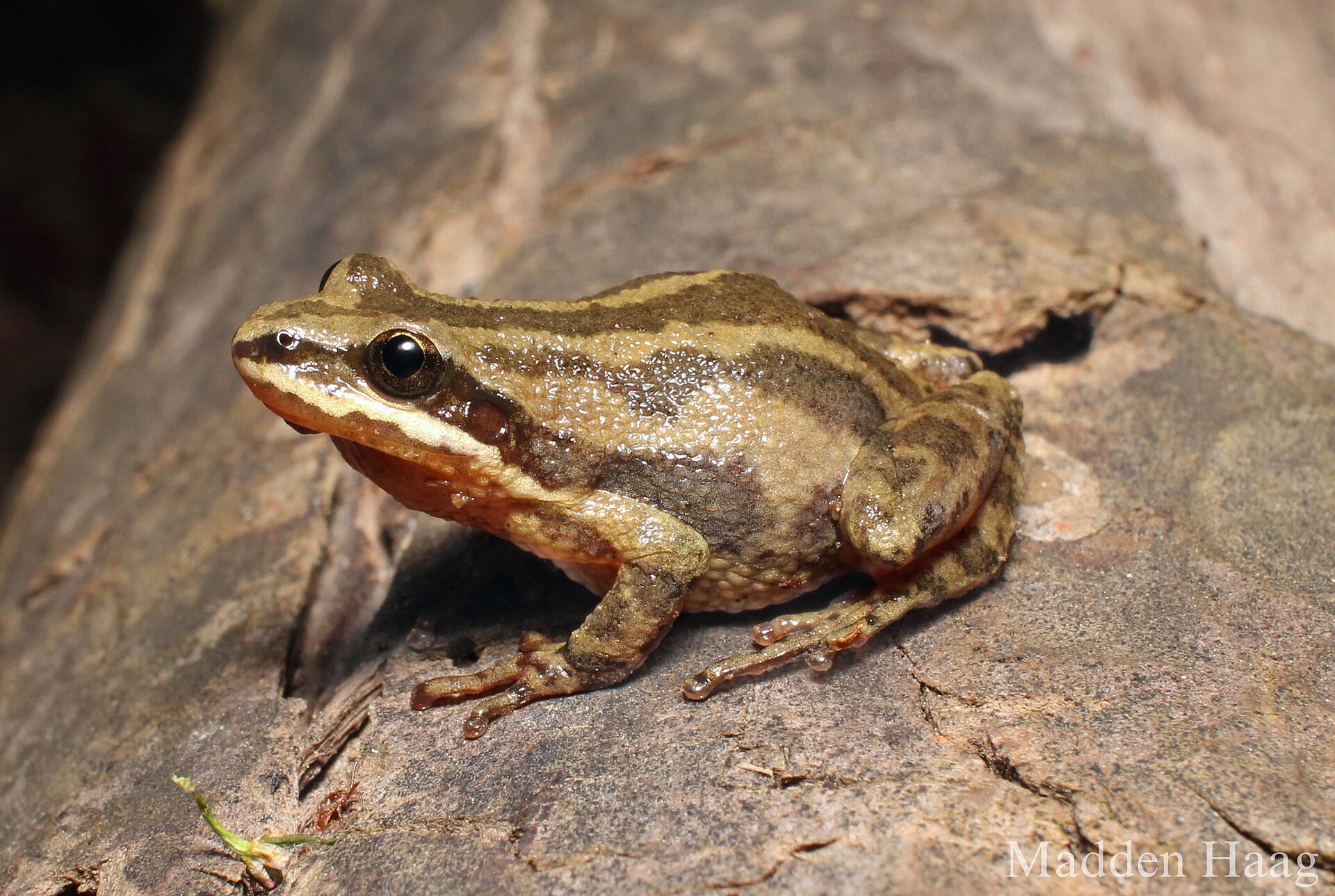
MH Herpetology, CC BY-SA 4.0, via Wikimedia Commons
Pseudacris feriarum
Habitat: Closely associated with fish-free seasonal pools, cattail marshes, river floodplains, and ditch habitat by railroads.
Seasonality: May be heard calling as early as mid-February and into April.
Call: Rapid and hollow-sounding ascending scrape akin to dragging a fingernail along the teeth of a plastic pocket comb. Described as a repeated “Wrrrrank” or “Wrrrrack”.
Description: Small, tan to brown body with three darker colored stripes running down the back. A dark stripe runs along each side of the body from the snout to the hip. A triangle or y-shape is typically present on the back of the head behind the eyes, and a light line runs along the upper lip.
Notes: Maryland State Species of Greatest Conservation Need (SGCN). More data needed but may largely be extirpated (locally extinct) from Montgomery County.
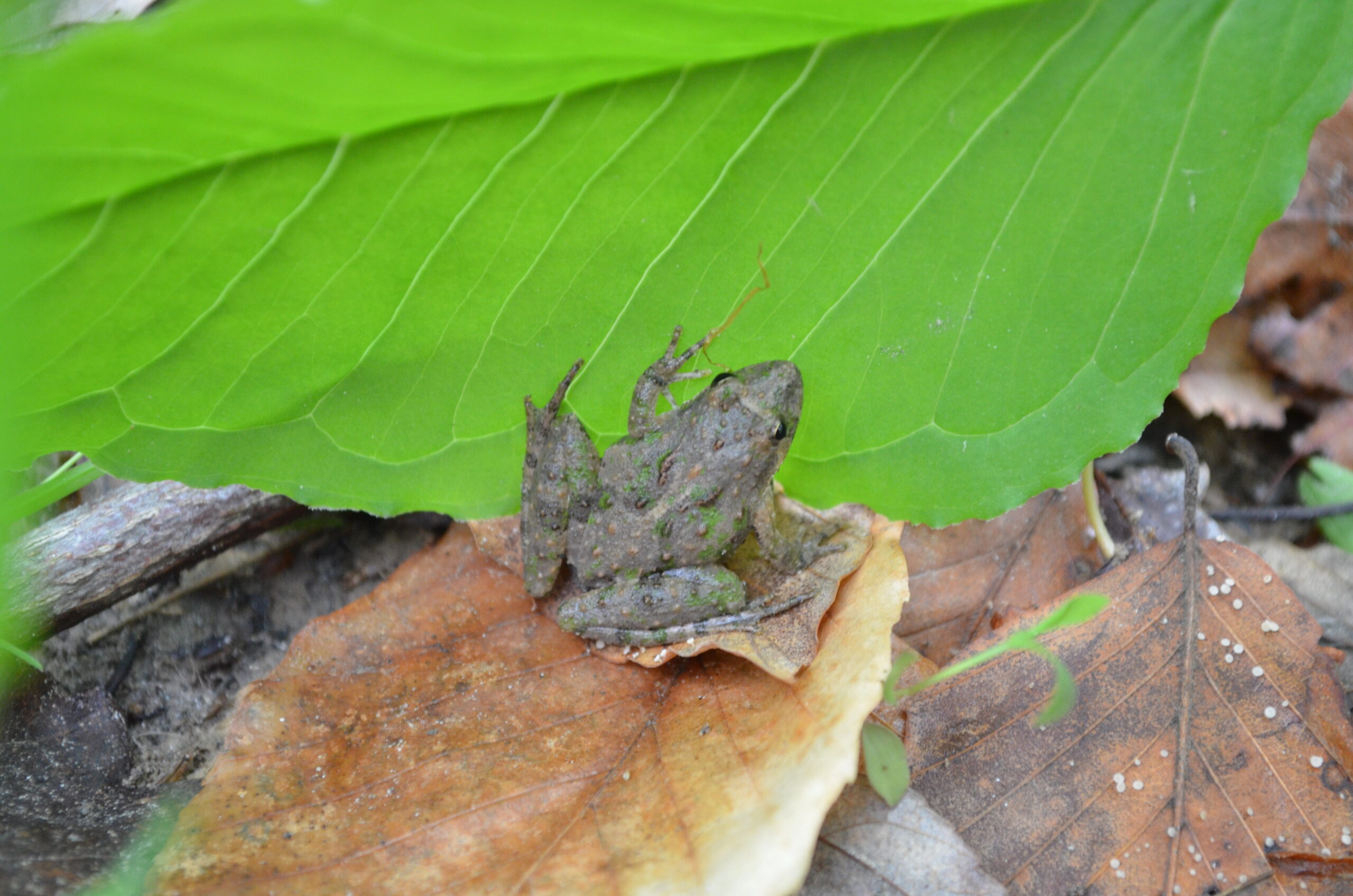
Acris crepitans
Habitat: Prefers wetlands with open areas; often observed along the shoreline of streams, marshes, ponds, and lakes.
Seasonality: Typically heard calling from late spring (April) and well into the summer (July).
Call: Sharp, measured clicking and reminiscent of two glass marbles being tapped together or like the shaking of a spray paint can. Tends to start out slowly and then accelerate in rapid succession.
Description: Small and rarely exceeding 1” this frog has a somewhat pointed snout and is covered in fine warts. Coloration is highly variable, with splashes of green, brown, and even rust-like coloration, but a dark, rear-facing triangle will be present between the eyes. There is also a dark stripe that runs down each thigh and the length of the hind legs are shorter than most other treefrogs.
Notes: Uncommon in Montgomery County and primarily found near the Fall Line between the Piedmont and Coastal Plain and in watersheds such as the Little Paint Branch of the Anacostia River. Tends to move in quick, somewhat erratic leaps, quickly retreating to water or hiding among vegetation.
True Toads
True Toads (Bufonidae Family) are stout-bodied with relatively short legs, and move in small hops rather than in the long leaps of other frogs. The skin is covered in warts, and they have a pair of specialized, kidney-shaped glands (parotoid glands) on the back of the head behind each eye, which are used to produce bufotoxin as a defense mechanism. The shape of the parotoid glands, as well as the connection to the bony structures around them (the cranial crests) can be used to help identify species. The character of the skin warts, including their count within dark spots on the back, and their size on the rear legs, can also help distinguish species. True Toads in North America also lay eggs stacked in long strings, reminiscent of strands of pasta or shoestrings floating in the water. Tadpoles are small and mature quickly, metamorphosing into tiny toadlets and taking several years to reach their full adult size.
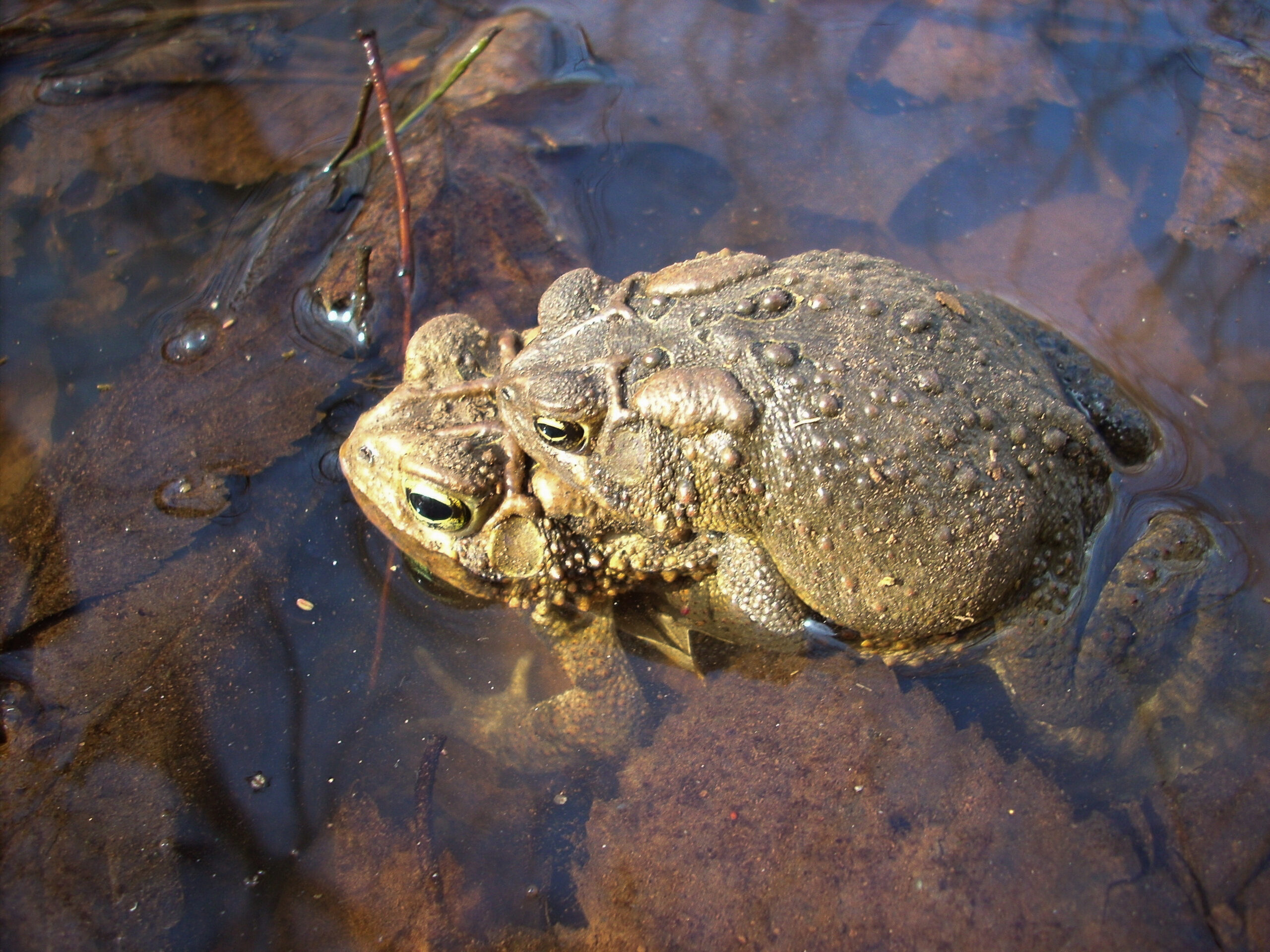
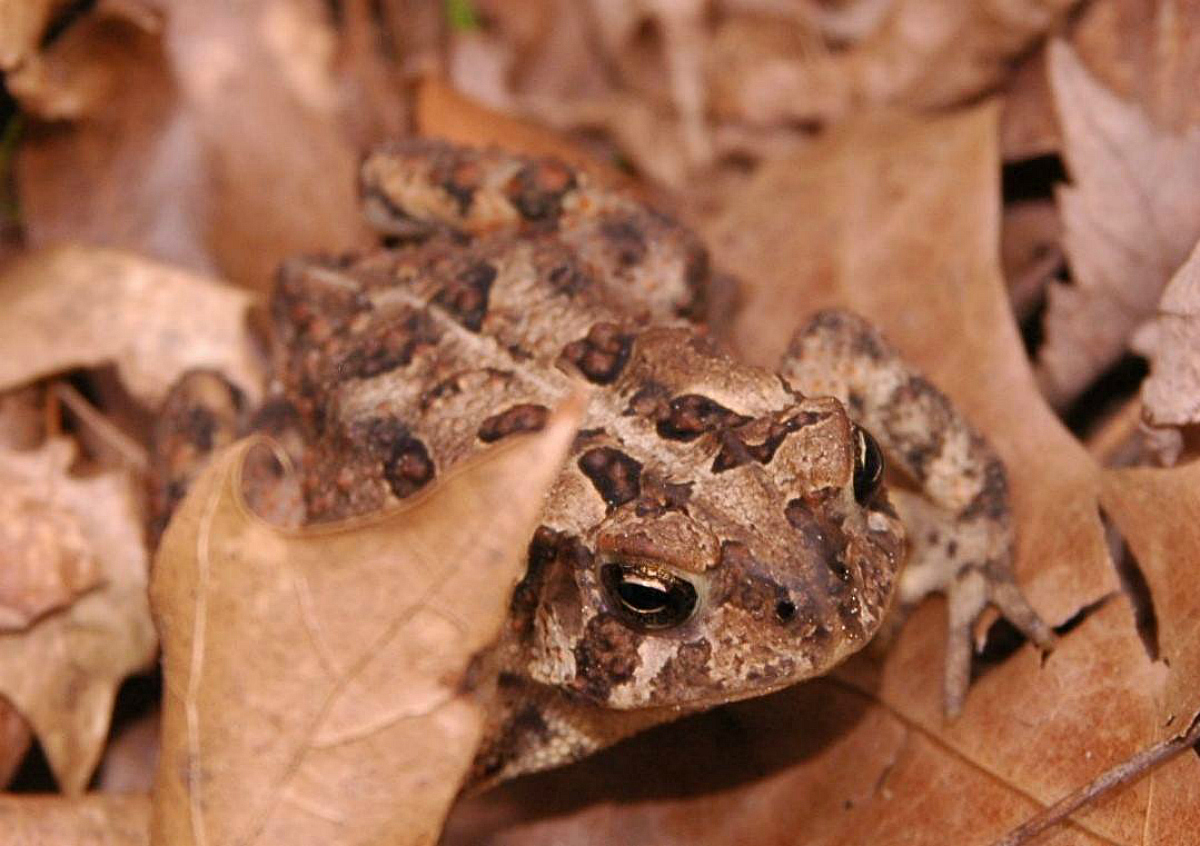
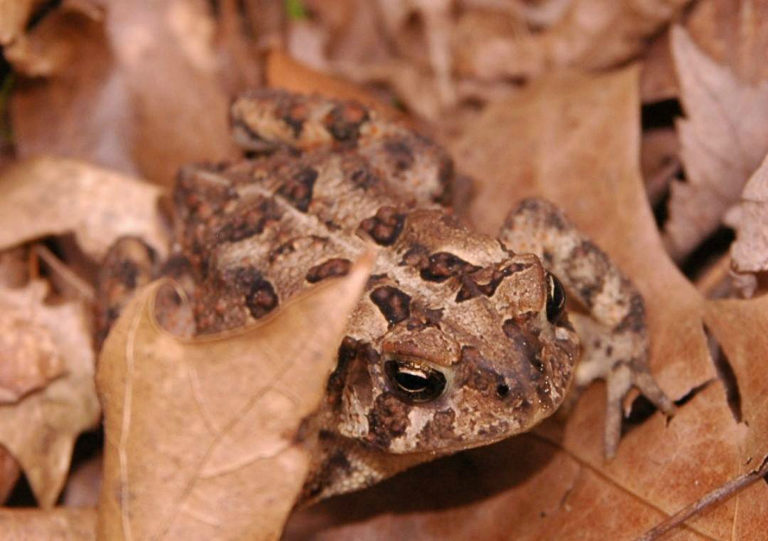
Anaxyrus americanus
Habitat: Will utilize most shallow wetlands for breeding, including ditches, tire ruts, and flooded fields and grasslands. Individuals can be found in a variety of habitats from stream floodplains to meadows and gardens outside of the breeding season.
Seasonality: Calls and breeds from March through May, typically shortly after Wood Frogs and other early season breeders.
Call: A pleasant, musical trill lasting 5 to 30 seconds. May resemble a simultaneous whistle and hum.
Description: Overall color can vary across many shades of brown, often resembling the soil where found. Key features of the American Toad (A. americanus) that can be used to distinguish it from the Fowler’s Toad (A. fowleri):
- One to two warts per dark spot on the back. These warts are typically larger in size when compared with other toad species.
- Large warts on the rear leg, especially on the tibia.
- A throat and belly that are white or cream-colored and covered in dark freckles and blotches.
- The cranial crest and parotoid glands are separated or connected by a short spur.
Notes: More frequently encountered than the Fowler’s Toad in Montgomery County. Males of both species will develop a dark throat during the breeding season.
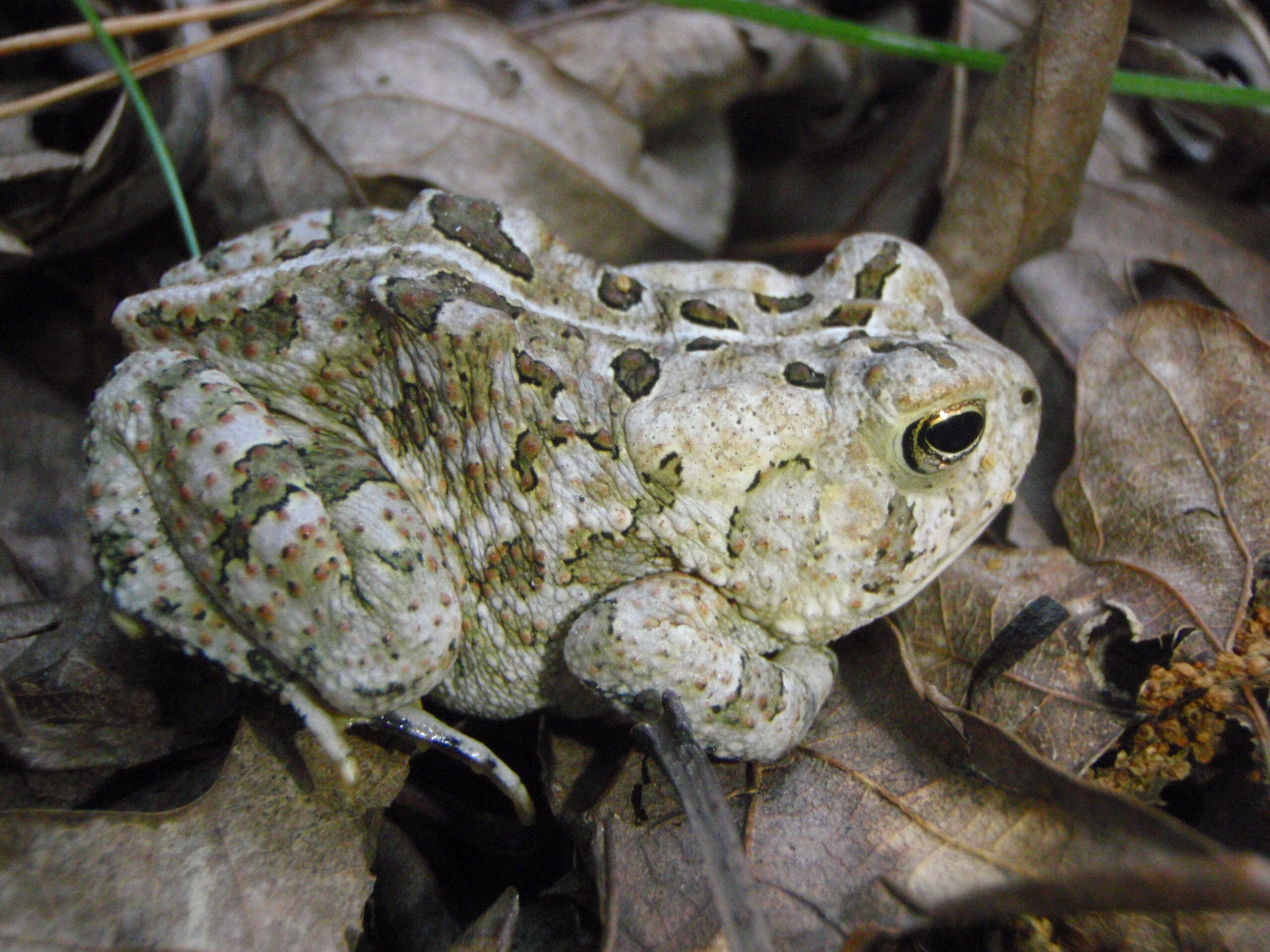
Anaxyrus fowleri
Habitat: Like the American Toad, Fowler’s Toads breed in shallow aquatic habitats and favor forests and meadows when not congregating to breed.
Seasonality: Typically April through May, but occasionally into the summer.
Call: A short, nasal cry lasting 1-4 seconds, described as a buzzy and shrill “Waaaah”.
Description: Overall color can vary from brown to gray. A narrow, light-colored stripe runs down the center of the back and along the spine in most individuals. Key features of the Fowler’s Toad (A. fowleri) that can be used to distinguish it from the American Toad (A. americanus):
- Three warts per dark spot on the back. These warts are typically smaller in size when compared with other toad species.
- A throat and belly that are white or cream-colored with a single dark spot at the center of the chest.
- The cranial crest and parotoid glands are connected, with the bottom of the crest largely resting atop the gland.
Notes: Tends to be encountered less frequently in Montgomery County and is more closely associated with loose, sandy soil than the American Toad.
Spadefoot Toads
American Spadefoot toads (family Scaphiopodidae) are a small group with some unique features, including a pronounced, hard structure made of keratin on each rear foot that helps them to dig backwards into sandy soil. They lack the paired parotoid glands seen in true toads (family Bufonidae) and have prominent, high-set eyes with vertical pupils. Only one species is found in the Eastern United States, including in Montgomery Parks.
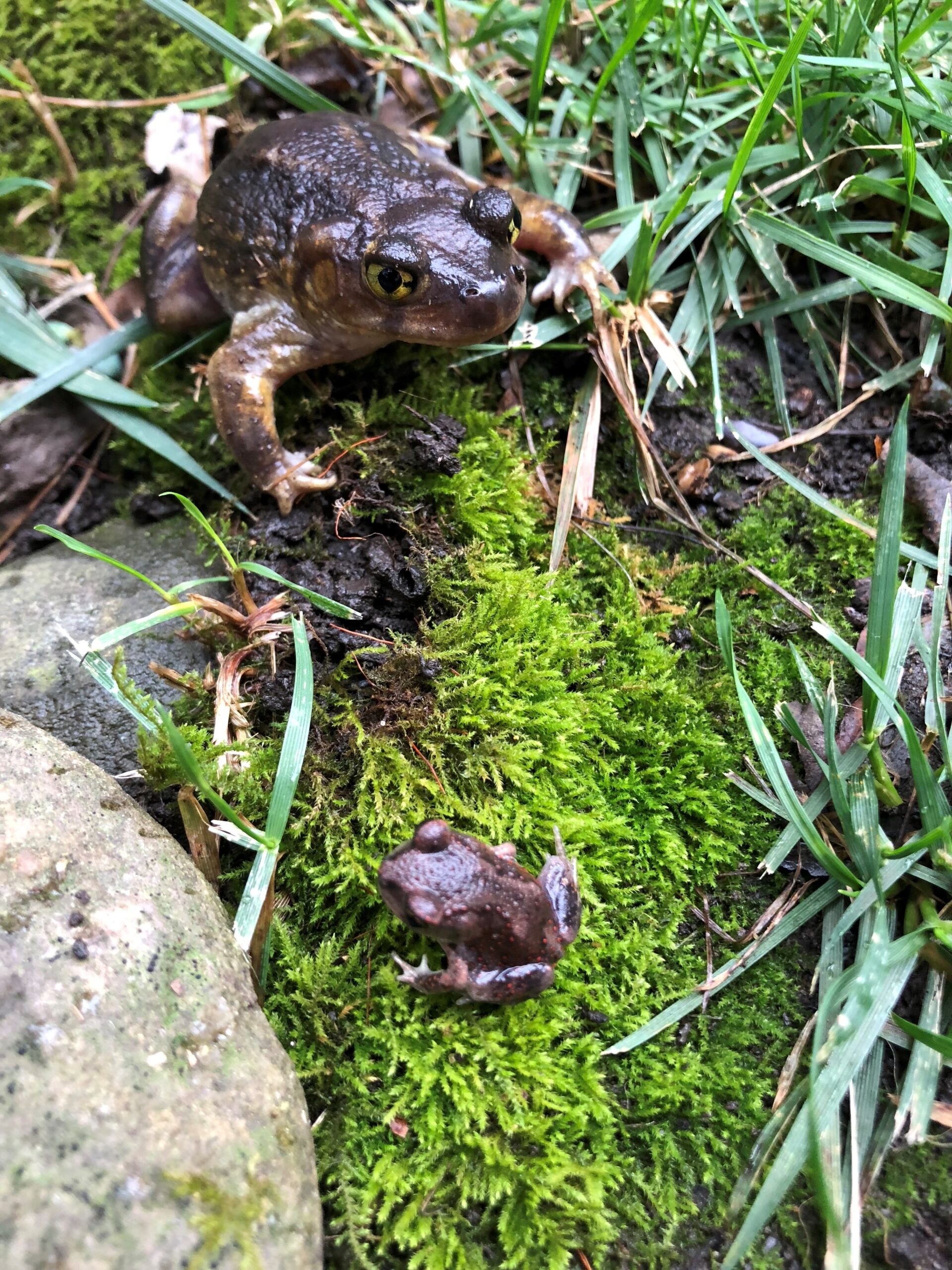
Scaphiopus holbrookii
Habitat: Primarily lives underground or beneath cover, emerging only during very heavy rains to breed in temporary ponds and other small, temporary (ephemeral) wetlands that are free of fish predators. They are typically associated with sandy soil which facilitates burrowing.
Seasonality: May be heard from March through September, but only following heavy rainfall. Calling and breeding are limited to a few nights a year and can be skipped during drought years.
Call: A short, accented and low-pitched grunt that trails off at the end.
Description: Squat body and very bulgy eyes with vertical, cat-like pupils. Lyre-shaped yellow lines are present on the back along with small, reddish-orange warts. May be seen in burrows with only the top of head visible.
Notes: Not well-documented in Montgomery Parks; more data needed. Report a sighting or send a recording to frogwatch@montgomeryparks.org with location coordinates if encountered.
Become a FrogWatch Community Scientist
About Montgomery FrogWatch
Recruitment for the 2026 FrogWatch season has ended. Sign up for our emailing list and receive updates on our next volunteer effort.
Montgomery Parks and the Montgomery County Department of Environmental Protection cohost a local chapter of a national amphibian monitoring program, FrogWatch USA. Volunteer community scientists receive training on how to recognize and collect data on the breeding calls of frogs and toads heard after dusk at wetlands and contribute to the FrogWatch-FieldScope national database. Data collected by Montgomery Parks volunteers are used to increase understanding and inform habitat management decisions, while also contributing to a nationwide dataset dating back to 1998.
Participants must register with the Volunteer Services Office to collect data in Montgomery Parks, but the Montgomery FrogWatch chapter can also provide training and local resources for monitoring in your neighborhood or another favorite place that frogs and toads frequent.
To see if the program is a good fit for you:
- Preview the monitoring protocol (accessible pdf);
- Review instructions for volunteering through Montgomery Parks (pdf) and submit a volunteer application (open seasonally);
- Find an existing listening site or locate a new one via the interactive map;
- Receive training on species identification and data collection procedures;
- Plan to commit to adopting an aquatic monitoring site, submitting data to the FrogWatch-FieldScope National Database, and logging your volunteer hours with Montgomery Parks.
Need Training?
The Montgomery FrogWatch chapter hosts training opportunities and resources for learning about local species and how to collect data as part of the FrogWatch USA national monitoring program.
The Montgomery FrogWatch chapter offers training opportunities annually and typically scheduled in late winter or early spring.
2026 Training Dates
Training opportunities will be held on the following Thursdays from 7:00 – 9:00 p.m.:
- February 26 – FrogWatch Training Part 1 – VIRTUAL (& Recorded) Session
Participants will learn protocols and procedures for registering and monitoring listening locations, collecting data in Montgomery Parks, and tips for species identification. - March 12 – FrogWatch Training Part 2 – IN-PERSON Field Excursion at Maydale Nature Classroom (Colesville)
Put what you have been practicing into place! Following a classroom review, we will head to the field to practice registering a listening location and collecting data. We will return to the classroom to enter data, log volunteer hours, and address any remaining questions.- Spanish-speaking staff will be in attendance.
- Inclement weather date is March 19.
- Registration opens following virtual session.
- Note: This is an OPTIONAL training. Completion of Part 1 or online training (see below) is all that is required.
In field training and review opportunities are also available through Monthly Monitoring Meet Ups (see below).
Check back for updates or join the Montgomery FrogWatch emailing list to receive the latest program information.
A free self-paced online volunteer training and orientation course is available through the Akron Zoo, the national host for FrogWatch USA.
Please contact the Montgomery Parks FrogWatch Coordinator with your certificate of completion to receive further instructions on chapter participation.
Park naturalists and volunteer master naturalists lead group monitoring visits at a subset of Montgomery FrogWatch sites for participants who do not want to monitor at night alone or would simply like to enjoy the company of others interested in helping frogs and toads and their habitats in Montgomery Parks. Montgomery Parks also hosts a variety of frog-focused programming for learning more about our amphibian neighbors.
2026 Group Opportunities
- Community Science Night Hikes – Locust Grove Nature Center
(Cabin John Regional Park, Bethesda)- Join a park naturalist and other volunteers for FrogWatch data collection as well as to enjoy the natural wonders of the park after dark.
- Saturdays: March 7, April 4, May 2.
- Monthly Monitoring at Rock Creek Stream Valley Park and Nature Forward’s Woodend Sanctuary (Chevy Chase)
- Join a Maryland Master Naturalist for a unique opportunity to collect and compare data from an ecological restoration site with wetland habitat on neighboring parkland.
- Mondays: June 8, July 6, August 3
- Contact the site leader to join one or more sessions. Summer sessions start at 9:00 p.m.
Join the e-mailing list to receive the latest program announcements and updates.
Resources and Reminders for Returning Volunteers
Welcome back! Veteran volunteers like you keep the program going, and your knowledge and dedication are truly appreciated!
Please:
- Check the interactive map to confirm site availability and visit any parks or sites of interest to confirm conditions. Returning volunteers receive priority, but assignments are generally first-come, first-served. Note that we may also assign multiple volunteers to one location, where appropriate.
- Contact the Montgomery Parks FrogWatch coordinator with your site selection and request a monitoring permissions packet for the season. Montgomery Parks close after sunset, and you cannot visit your site and monitor at night without permission.
- Review species calls and the monitoring protocol.
- Log your hours! Time reviewing materials, traveling to and from your site, and collecting and entering data are all eligible activities.
- Ask questions and have fun! Data is downloaded and reviewed monthly, but we are always happy to see photos, listen to recordings, or hear about neat things you notice at nature’s nighttime nurseries!
Additional training is encouraged, but not required.
It is critical to check any potential monitoring locations during the day to ensure they are safe and accessible for nighttime data collection. Additionally, wetlands are dynamic systems that change across seasons, year-to-year, and in response to changes in the surrounding landscape. That is one of the reasons we monitor them!
Happen upon a cool vernal pool or other wetland that is not particularly accessible at night? We want to document those, too! Just make sure you are registered as a FrogWatch Community Scientist. Permission packets can be issued to allow off-trail access.
Unable to make nighttime observations? You can still participate in site reconnaissance during the day. Visit existing sites to confirm details or complete the site registration process for any new wetland listening locations you find. Email site photos and new or updated site registration forms to the Montgomery FrogWatch Chapter Coordinator.
What Are We Learning?
Montgomery FrogWatch chapter volunteers have contributed 1,365 observations (and counting!) to the national database since 2014.
In 2025:
- Montgomery FrogWatch volunteers made 83 observations across 52 visits at ten listening locations.
- Nine species were heard at 80% of visits to aquatic habitats in Montgomery Parks!
- The most common species detected were Spring Peeper, Green Frog, Gray Treefrog, Pickerel Frog, and American Bullfrog. These were the same top five species documented in 2024.
- When combined with volunteers monitoring outside of Montgomery County Parkland, the Montgomery FrogWatch chapter contributed more than 100 monitoring observations to the National FrogWatch USA database, which exceeds 200,000 observations and 16,500 contributors nationwide!
From 2021 to 2025, there have been:
- 684 observations of 10 frog and toad species made by more than 34 volunteers.
- One or more species heard during 67% of all monitoring visits.
- An additional 147 observations contributed by 10 volunteers off of Montgomery County Parkland.
Volunteers are contributing valuable information about wetland habitats in Montgomery Parks:
- 62 wetland listening locations have been monitored in Montgomery Parks since 2021, creating a long-term data set that will continue to grow each year.
- Volunteers have documented 29 vernal pool locations through site reconnaissance and registration and confirmed 17 observations of Wood Frogs, an obligate species that requires these unique wetlands to breed.
- Created vernal pools host Wood Frogs and may be visited and used by others such as American Toad, Spring Peeper, Gray Treefrog, Cope’s Gray Treefrog, Green Frog, and American Bullfrog. But some locations may not hold enough water to support successful breeding every year.
- The habitat enhancement project outside of Locust Grove Nature Center supports seven species (2023-2025). Spring Peeper, Green Frog, Gray Treefrog, and Cope’s Gray Treefrog were heard in 2025, and Wood Frog tadpoles were sighted as well.
Frequently Asked Questions
Volunteering as a FrogWatch Community Scientist can take as little as 15 minutes a month! Learn more about the specifics of the data collection protocol and how it relates to the breeding and calling behavior of frogs and toads.
When is the FrogWatch data collection season?
The FrogWatch data collection season coincides with frog and toad breeding and calling, and is from February 1 through August 31 nationally.
Do I have to collect data only at night?
Yes, the standardized national protocol developed in 1998 specifies that observations are to be made at least 30 minutes after sunset and conclude by 1:00 AM. Montgomery FrogWatch volunteers receive special permission packets authorizing them to access certain areas of parkland after hours.
How long am I supposed to listen?
You can listen to frogs and toads for as long as you’d like, but the standardized data collection protocol requires that you wait a minimum of two minutes for an acclimation period followed by a listening observation/data collection period of exactly three minutes.
If you want to collect additional data, you are encouraged to visit your monitoring site more frequently or adopt additional sites.
Why do I have to go to a wetland to listen?
Wetlands are nurseries for frogs and toads. This is where they congregate to breed and lay eggs. The data you collect on frogs and toads is also telling us about the condition of the aquatic habitat and the overall health of the environment.
Why are volunteers needed?
Montgomery Parks has a robust stream biological monitoring program and collects data on wetlands where we can, but volunteers are needed to fill in the gaps. By adopting an aquatic habitat, you are also giving us information to examine trends over time. Moreover, we are actively evaluating areas where we can create or enhance habitats, so you can help us prioritize and document our success!
Why do frogs and toads call?
To communicate, of course! The main sounds of spring and summer are breeding advertisement calls where males are trying to attract mates, but they can also make noises in scuffles over territories and mates, as well as alarm calls when threatened by a potential predator.
Do all frogs and toads call?
Yes, in Maryland, but only males call. Each species makes a unique breeding vocalization, just like songbirds.
When do frogs and toads call?
Because calling is associated with breeding, calls and choruses are heard in spring and summer, or from about mid-to-late February through the end of August locally. Chorusing can happen during the day, but is more common at night across species and under the safety of darkness, when there is less competition from other sounds, like bird calls.
Learn More about Frogs and Toads
Parkland managed by Montgomery Parks makes up more than 10% of Montgomery County’s land and serves as the County’s “backyard”, comprising more than 37,000 acres of land, over 600 stream miles, and thousands of wetlands, ponds, and stormwater facilities. But these resources do not stop at our boundaries. Learn more about enjoying amphibians and their habitats in Montgomery Parks and how you can contribute to their conservation in your own neighborhood.
Frogs and toads are among the many types of wildlife that live in Montgomery Parks. Keep an eye – and an ear – out along your favorite trail, stream, or wetland area and keep the following in mind:
- Remain on trails and tread carefully. Frogs and toads can be highly camouflaged and may be hidden under leaves and other cover. They may also cross trails, particularly during dusk and following rain.
- Watch out for wet areas. Even puddles on a trail can offer a quick oasis for wet-skinned amphibians. Avoid trampling or riding bikes through these areas.
- Wetlands are nature’s nurseries. Entering them increases disturbance and the potential for spreading pathogens from one habitat to another.
- Keep dogs leashed to prevent them from disturbing or harming wildlife or entering sensitive habitat. Pick up and dispose of pet waste responsibly.
- Handling can harm. Frogs and toads may be charismatic, but they should be admired and left undisturbed. They have sensitive skin and can be hurt when handled roughly and when contacting sunscreen, lotion, and insecticide.
Follow Montgomery Parks Rules and Regulations:
- Collection is not allowed. Per Montgomery Parks Rules and Regulations, Section 18. Animals and Wildlife: “No person shall catch, capture, touch, feed, injure, destroy, or interfere in any way with any wildlife on Park Property, except as otherwise provided by Chapter V Section 8 (Fishing) and Section 11 (Hunting/Trapping).
- A scientific collection permit issued by the Wildlife Ecology Unit or Aquatic Ecology Unit is required for scientific and educational activities.
- The use of traps, electrofishing, or other restraint and collection methods requires an Aquatic Scientific Collection Permit from the State of Maryland and written permission from the Aquatic Ecology Unit of the Park Planning & Stewardship Division.
- When angling, avoid intentional hooking or harm to other animals, including the collection of reptiles, amphibians, and minnows for bait.
- Do not release animals on Parkland. This activity is prohibited and harmful. It is illegal to introduce aquatic species and release live bait in Maryland. This includes unwanted pets and wildlife moved from one area to another.
Be a good neighbor to frogs, toads, and other amphibians by creating healthy habitats and preventing pollution. A few everyday ideas, and why individual actions matter:
- Skip pesticides and lawn chemicals, which are absorbed through amphibian skin and impact food sources.
- Minimize de-icer application. Excess salt and other chemicals can be lethal to amphibians and pollute aquatic breeding habitats.
- Reduce lawn area and plant native vegetation to create a more balanced ecosystem.
- Leave pocket habitats such as areas of leaf litter, tall grasses, and other natural cover for shelter. Mulch and compost areas can also hold moisture and offer shade and places to hide and find food.
- Create a pet-free zone in your yard. Dogs and cats can hurt amphibians and dog waste can make them sick and pollute aquatic habitats.
- Be mindful of nighttime lights. Bright lights may attract insects and the frogs that follow, but they also expose amphibians to potential predators and can disrupt nocturnal behaviors.
- Watch what goes down the drain. Sinks and streets can be common sources of water pollution. Do not flush or wash medications down the drain. Additionally, storm drains do not go to sanitary sewers, and many go straight to streams, picking up and transporting pollution along the way.
If you encounter a frog or toad and would like to know more about the species, or have questions, take a photograph and contact the Montgomery FrogWatch Coordinator.